
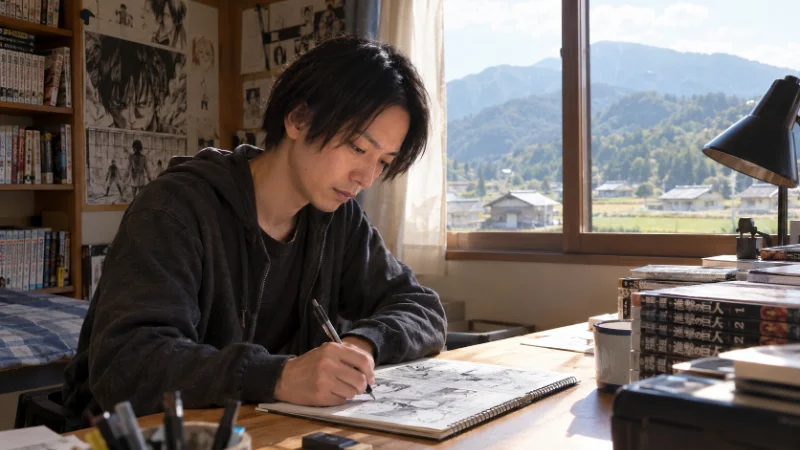
Hajime Isayama is the Japanese manga artist who created Attack on Titan, a series that sold more than 140 million copies worldwide and became one of the best-selling manga franchises in history, with 140 million copies in circulation as of November 2023. He is known for building a story that mixed war drama, horror, and political allegory into a shonen manga format that rarely goes that dark.
What makes Isayama’s story worth understanding is not just the sales numbers. It is the path of a small-town outsider from rural Japan who got rejected by the country’s biggest manga publisher, refused to change his style to fit in, and ended up reshaping what a mainstream manga could look like.
Early Life in Rural Oita
Isayama was born on August 29, 1986, in Ōyama, a small town in Ōita Prefecture that is now part of Hita City. Isayama was born in Ōyama, Ōita Prefecture, Japan, which is now part of Hita City. According to Lambiek Comiclopedia, he enjoyed drawing from a young age, and his interest in manga grew after an elementary school teacher gave his class an assignment about recycling that led him to discover discarded manga magazines.
He did not have an easy relationship with his hometown. Isayama described Oita as a secluded, isolated place surrounded by mountains, and he sometimes wished something dramatic would happen there to break the monotony. That restlessness shows up later in Attack on Titan, a story literally built around characters trapped behind walls who dream of the world outside.
His artistic influences included Hideki Arai, George Morikawa, Koji Seo, Ryoji Minagawa, Kentaro Miura, Tsutomu Nihei, and Makoto Yukimura, a mix that leans toward dense, detailed, and often violent storytelling rather than typical shonen fare.
Education and the Move to Manga Design
Isayama attended Hita Rinko Senior High School, where he began submitting manga works to contests. After graduating, he enrolled in the manga design program of the arts department at Kyushu Designer Gakuen, a specialized art school in Fukuoka. He supported himself during this period with part-time work at an internet café.
This detail matters because it shows Isayama did not come up through Japan’s traditional assistant system under an established mangaka. He trained formally in illustration and design, then tried to break in directly with his own concept, which is a less common route into professional manga.
The Rejection That Shaped His Career
In 2006, Isayama first approached Shueisha’s Weekly Shōnen Jump, the magazine behind Naruto and One Piece, with an early version of Attack on Titan. His work was rejected there, and he was told to modify his style to better fit the magazine’s house approach. Rather than compromise, he took the manuscript to Kodansha’s Weekly Shōnen Magazine department instead.
That decision paid off almost immediately. He applied for Kodansha’s Magazine Grand Prix in 2006, and a short version of Attack on Titan won the Fine Work award. He also picked up a Special Encouragement Award for a different one-shot, Heart Break One, in Kodansha’s 80th Weekly Shōnen Magazine Freshman Manga Award competition in 2008.
The gap between his first recognition in 2006 and the actual serialization of Attack on Titan in 2009 is a detail most profiles skip. Isayama spent those years refining the concept and drawing one-shots before Kodansha committed to a full series, a slower and less glamorous build than the “instant hit” narrative usually attached to him.
Attack on Titan: From Serialization to Global Franchise
Attack on Titan began serialization in Kodansha’s Bessatsu Shōnen Magazine in 2009 and ran until 2021. The story follows humanity confined behind massive walls to survive against man-eating Titans, only for the plot to reveal a much larger political and historical conflict behind the walls’ existence.
The series became a defining modern manga. It reached 140 million copies in circulation as of November 2023, and its anime adaptation, produced across multiple studios, became one of the most-watched anime series worldwide.

Isayama received the Kodansha Manga Award in 2011 for the series, and a Harvey Award in 2014, recognizing him internationally rather than only within Japan’s domestic industry. In 2023, France gave him one of the medium’s most prestigious honors: he was awarded the Fauve Spécial at the 50th Angoulême International Comics Festival, a distinction that placed him alongside some of the most respected names in global comics, not just anime and manga.
Local Recognition Back Home
Isayama’s success also reshaped his relationship with the region he once wanted to escape. A resort near his hometown of Ōyama ran a free exhibit of his manuscripts in 2013, and a dedicated Attack on Titan event was held in Hita in November 2014, drawing roughly 2,500 attendees. The following day, Isayama gave a speech at Hita’s Patria cultural hall and was officially named the city’s Tourism Ambassador.
It is a detail that reframes the “escaped his hometown” narrative many quick profiles lean on. Isayama did not just leave Oita behind. He became one of its most visible cultural exports, and the town leaned into that connection rather than treating him as a departed local.
The Ending That Divided Fans
Attack on Titan’s manga concluded in April 2021, and the finale became one of the most argued-over endings in modern manga. The story gives protagonist-turned-antagonist Eren Yeager a conclusion that some readers found tragic and fitting, and others found rushed or morally uncomfortable given the scale of destruction his character causes.
Isayama has spoken about this more than once, and his comments have shifted over time rather than settling into a single tidy explanation. At a 2023 Anime NYC panel, he said he felt intense pressure to give Eren a heroic ending despite Eren’s terrible actions, and that he wanted to show Eren was fundamentally goodhearted, though he acknowledged the choice did not land the way he hoped.
He has also given a more self-critical account. According to a plaque at Japan’s Attack on Titan Museum, Isayama admitted that Attack on Titan had stopped being his story alone, since Eren had become a character loved by many readers, and that instead of fully committing to portraying Eren as a detestable figure, he ended up writing him with a degree of closeness and sympathy that left a sense of insincerity in the story’s conclusion, at least by his own assessment.
There was also a version of the ending that never made it to print. Isayama has described an earlier, far bleaker direction for the finale. He said he did not want to betray Eren, Mikasa, and the rest of the cast with a purely hopeless conclusion, and that fan devotion built over the years pushed him away from a darker, more nihilistic ending toward the more bittersweet one readers actually got.

Put together, these statements show a creator who was genuinely torn between the story’s internal logic and his emotional attachment to characters he had spent over a decade building, then second-guessed the balance he struck. That tension, more than any single quote, is the real story behind the ending’s reception.
Personal Life
Isayama keeps his personal life largely private. He married in 2018, but has not publicly identified his spouse, and there is no confirmed public information about children. Reports about his net worth, height, or other personal statistics circulate widely online, but figures vary significantly between sources and are not independently verifiable, so they are best treated as rough estimates rather than confirmed facts.
Life After Attack on Titan
Since the manga’s conclusion, Isayama has stayed connected to the franchise rather than disappearing from it. He has remained involved in adjacent projects, including storyboarding work tied to anime adaptations of his story and companion projects such as the two-part compilation film Attack on Titan the Movie: The Last Attack, released in 2024. As of now, there is no publicly confirmed word on a new original manga series from Isayama, and any future project should be treated as unconfirmed until he or Kodansha announces one directly.
Why Isayama’s Career Matters Beyond the Sales Numbers
Isayama’s real influence on manga is less about the copies sold and more about what he proved was commercially viable. Shonen manga aimed at young male readers had rarely gone as bleak, morally ambiguous, or politically pointed as Attack on Titan did, especially in a story where the line between hero and villain kept dissolving. Its success opened space for other creators to bring darker, more morally complex storytelling into mainstream manga without it being treated as a niche seinen experiment.
He is also one of the clearest recent examples of a manga artist’s work translating into sustained Western cultural relevance, evidenced by the Harvey Award and the Angoulême honor, both recognitions that came from outside Japan’s own industry structure. That crossover matters because it reflects an audience response, not just a marketing push.

His willingness to publicly reconsider and criticize his own ending, rather than defend it uniformly, is unusual for a creator of his stature. It suggests a working method built more on doubt and revision than on certainty, something that likely shaped Attack on Titan’s tonal ambiguity from the start.