Most people search her name after learning she is Quincy Jones’s oldest child, and that single fact tends to end the conversation before it starts. Jolie Jones Levine was born on October 4, 1953, in Manhattan, four years before her father produced his first hit record. She has spent the decades since building a career and a family of her own, one that includes a marriage to a working producer and a son who now makes records for a new generation of artists.
Her story is not the story of a famous name attached to nothing else. It is the story of a modeling career that started before she was out of her teens, a handful of film and television credits, and a household that quietly became its own small music dynasty.
Quick Facts
| Category | Details |
|---|---|
| Full Name | Jolie Jones Levine |
| Born | October 4, 1953, in Manhattan, New York |
| Parents | Quincy Jones and Jeri Caldwell |
| Profession | Former model, actress, producer, and vocalist |
| Known For | Eldest of Quincy Jones’s seven children; former Ford model; film and soundtrack credits including Panic in Echo Park (1977) and Hunk (1987) |
| Spouse | Stewart Levine, record producer known for his work with Hugh Masekela, the Crusaders, and Simply Red |
| Children | Sunny Levine (record producer) and Donovan Levine |
| Half Siblings | Rachel Jones, Martina Jones, Quincy Jones III, Kidada Jones, Rashida Jones, Kenya Kinski-Jones |
| Nationality | American |
Early Life in Manhattan
Jolie Jones Levine is the eldest of Quincy Jones’s seven children. Her mother, Jeri Caldwell, was Quincy Jones’s high school sweetheart and his first wife, and the two divorced in 1966 after several years of marriage strained by his constant touring and recording schedule. Jolie grew up mostly in New York before the family’s California years began.
Her six younger half siblings, Rachel Jones, Martina Jones, Quincy Jones III, Kidada Jones, Rashida Jones, and Kenya Kinski-Jones, came from her father’s later marriages and relationships. Jolie was already an adult with a modeling career by the time some of them were born. That gap in age is part of why her public story reads so differently from her more famous half sister Rashida Jones, who grew up in Los Angeles during her father’s most visible years in film and television.
A Teenage Modeling Career
Jolie signed with Ford Models as a teenager and appeared in magazines including Mademoiselle and Seventeen during the late 1960s and early 1970s. Modeling gave her an early public identity that had nothing to do with her father’s rising fame in music production, since Quincy Jones was still years away from his biggest commercial successes with Michael Jackson.
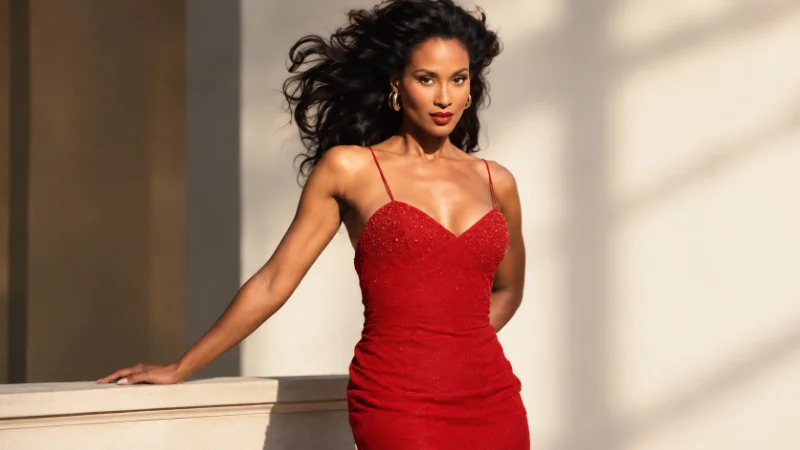
By her mid-teens she had relocated to Los Angeles, where she later interned at the Hollywood Professional School while continuing modeling work. Advertising campaigns for brands like Revlon and Max Factor followed, giving her steady work through her early twenties. Modeling was her first career, but it was not her last.
Finding Her Own Creative Voice
Acting and music pulled her focus away from modeling as she got older. She appeared in the 1977 film Panic in Echo Park, and a decade later her song “Take a Second Look” was featured on the soundtrack of the 1987 movie Hunk. Producer credits on smaller film and television projects rounded out this period of her career.
Music remained a constant thread. In the mid-1980s she moved to London with her family and worked on a singing career there, collaborating with artists connected to the British pop scene of the era. She later returned to Los Angeles, studied acting with coach Milton Katselas, and kept training as a vocalist alongside her acting work.
She has also been credited as a producer on projects tied to Brazilian musician Ivan Lins in the late 1980s. None of this reads like a headline career, and it was never meant to. It reads like the working life of someone who grew up around musicians and producers and simply kept making things.
A Marriage That Built a Second Production Dynasty
Jolie is married to Stewart Levine, a Bronx-born record producer whose career runs on a parallel track to her father’s. Levine left the Manhattan School of Music to work as a horn player and arranger before co-founding Chisa Records with South African trumpeter Hugh Masekela in the 1960s. He went on to produce Masekela for more than a decade, along with acts including the Crusaders, Minnie Riperton, Joe Cocker, B.B. King, Lionel Richie, and the British band Simply Red.
The two names, Quincy Jones and Stewart Levine, rarely appear together in the same sentence outside of family biographies, yet Jolie’s household connects two separate strands of soul, jazz, and pop production history. Her father shaped American pop through work with Frank Sinatra and Michael Jackson. Her husband shaped a different sound built on African township rhythms fused with American R&B and jazz.
Two Sons, One Family Tradition
Jolie and Stewart Levine have two sons, Donovan and Sunny. Sunny Levine became a record producer, songwriter, and film composer in his own right, working with artists including Jon Batiste, Scarlett Johansson, Shabazz Palaces, and Pete Yorn, and he also produced material with his father’s longtime collaborator, Hugh Masekela. He has described growing up surrounded by studios, with his father as producer, his uncle QD3 working in hip hop production, and his grandfather being Quincy Jones.
Donovan Levine has kept a much lower public profile than his brother and is rarely mentioned in coverage of the family beyond his name. Between Quincy Jones, Stewart Levine, and Sunny Levine, three generations of the same household have worked as record producers across three very different eras of popular music, which is a detail most short biographies of Jolie skip entirely in favor of repeating her father’s résumé.
Life Beyond the Camera
Profiles of Jolie consistently describe an interest in environmental causes that took shape after she scaled back her entertainment work to raise her sons. She is described as a founding member of a local chapter of an anti-nuclear group and later of the Earth Communications Office, an organization that connected the entertainment industry with environmental advocacy in the 1990s. Some sources also credit her with starting a personal environmental initiative called Take It Back.

These details come mainly from fan biography sites rather than major news outlets, so they should be read as widely repeated rather than independently confirmed by primary reporting. What is better documented is that she has spent long stretches of her adult life away from acting and modeling, occupied with painting, gardening, and raising her family in Los Angeles.
Losing Her Father: November 2024
Quincy Jones died at his home in the Bel Air section of Los Angeles on November 3, 2024, at the age of 91, surrounded by his family. His publicist, Arnold Robinson, confirmed the death, and the Jones children released a joint statement describing the loss as devastating while celebrating the life he lived. Jolie, then 71, was one of the seven children named in that statement alongside Rachel, Martina, Quincy III, Kidada, Rashida, and Kenya.
A private family funeral followed on November 10, 2024, attended by all seven children along with Quincy Jones’s brother, two sisters, and other immediate family. The family asked for donations to the Jazz Foundation of America in place of flowers and said a larger public memorial would be announced later. Jolie has kept a low public profile since her father’s death, avoiding interviews while her half sister Rashida has spoken more openly to the press about the family’s grief.
The Jones Family’s Multigenerational Sound
What makes Jolie Jones Levine’s story worth more than a passing mention is the pattern that runs through three generations of her family. Her father built one of the most influential production careers in American music history. Her husband built a separate but equally serious career producing African, jazz, and soul recordings on a different continent and timeline. Her son now produces records for contemporary artists working in entirely different genres again.

Jolie herself sits at the center of that pattern, not as a producer or a household name, but as the person who connects all three eras through marriage and motherhood. She built her own early identity through modeling and acting before her father’s fame reached its peak, then spent decades raising a family that quietly extended his industry’s reach into new music long after Thriller made his name a household word. That is a more specific and more accurate legacy than the vague description of “famous daughter” that most short profiles settle for.