
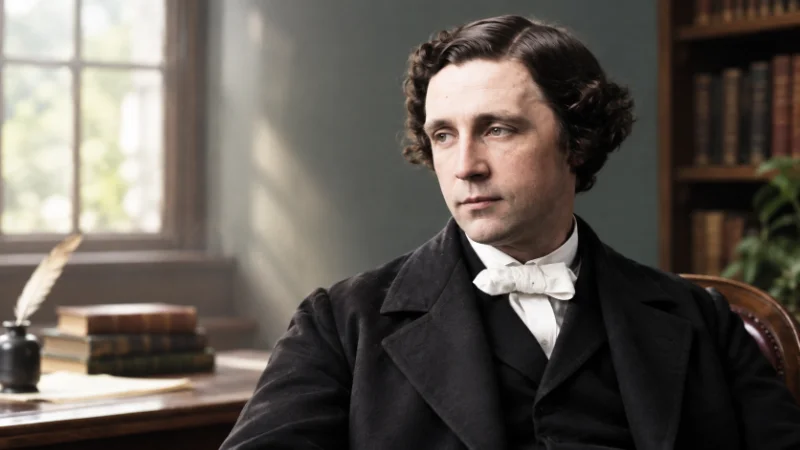
Lewis Carroll wrote one of the most recognized children’s books in the English language, Alice’s Adventures in Wonderland, yet the man behind the pen name spent most of his working life as a mathematics lecturer at Oxford. His real name was Charles Lutwidge Dodgson, and the gap between his quiet academic career and his wildly imaginative fiction is part of what still draws readers to his story more than 150 years later.
Early Life and Education
Charles Lutwidge Dodgson was born on January 27, 1832, in Daresbury, Cheshire, England. He was the eldest son in a large family of eleven children, and his father was a clergyman in the Church of England. Dodgson showed an early interest in wordplay, puzzles, and inventing games for his younger siblings, habits that later shaped the tone of his fiction.
He was educated first at Richmond Grammar School, then at Rugby School, where he struggled with the rough treatment common in English boarding schools of the period. In 1850 he enrolled at Christ Church, one of the constituent colleges of the University of Oxford, and it became the place he would call home for the rest of his life.
Real Name and the Birth of a Pen Name
Dodgson began writing poems and short pieces for magazines while still a student. When he wanted to submit work under a pseudonym, he settled on a method rooted in his own name. He translated Charles Lutwidge into Latin as Carolus Ludovicus, reversed the order, and anglicized it back into English, producing Lewis Carroll.
The name first appeared in print in 1856, and Dodgson kept his academic writing on mathematics and logic firmly separate from his literary work under the Carroll name. Colleagues at Oxford knew him as a meticulous, somewhat formal lecturer, while readers of Carroll’s books encountered a completely different voice, playful, absurd, and full of invented language.
Life at Christ Church, Oxford
Dodgson was appointed a lecturer in mathematics at Christ Church in 1855, a position he held for 26 years. As part of college tradition, he was also ordained a deacon in the Church of England in 1861, though he never proceeded to full priesthood, reportedly due to a stammer that made him uneasy about preaching regularly.
His mathematical output during this period included textbooks on Euclidean geometry, algebra, and logic, some of which are still referenced by historians of mathematics for their attention to formal rigor. Away from the lecture hall, Dodgson formed a close friendship with Henry Liddell, the Dean of Christ Church, and Liddell’s family, a connection that would soon shape the rest of his career.
How Alice’s Adventures in Wonderland Came to Be
On July 4, 1862, Dodgson took a rowing trip up the River Thames with a colleague, Robinson Duckworth, and the three young daughters of Henry Liddell: Lorina, Alice, and Edith. To pass the time, Dodgson improvised a story about a bored young girl named Alice who follows a white rabbit down a hole into a strange underground world.
Alice Liddell, then ten years old, later said she asked Dodgson to write the story down for her. He spent months expanding and illustrating the tale himself before eventually handing it to the novelist Henry Kingsley and illustrator John Tenniel for feedback. The finished book, Alice’s Adventures in Wonderland, was published in 1865 under the Lewis Carroll name, with illustrations by Tenniel replacing Dodgson’s original drawings.
The book combined logical wordplay, satirical Victorian references, and dreamlike nonsense in a way that had not been done for children’s literature before. It sold slowly at first but grew into a lasting commercial and critical success within a decade of publication.
Major Works Beyond Alice
1. Through the Looking-Glass and What Alice Found There
Carroll followed his first Alice book with a sequel in 1871, Through the Looking-Glass and What Alice Found There. This second book introduced the poem “Jabberwocky,” widely regarded as one of the most successful pieces of literary nonsense in English, and it built its plot loosely around the rules of chess rather than cards, as the first book had done.
2. The Hunting of the Snark
In 1876, Carroll published The Hunting of the Snark, a long narrative poem describing an absurd expedition by a crew of nine tradesmen and a beaver in search of a mysterious creature called a Snark. The poem is known for coining or popularizing several invented words and for its structured, almost mathematical approach to nonsense.
3. Later Fiction and Nonfiction
Carroll’s later fiction, including the two-volume novel Sylvie and Bruno, never matched the popularity of the Alice books. His nonfiction output continued alongside his fiction, including works such as Euclid and His Modern Rivals and The Game of Logic, which reflected his ongoing academic interest in formal reasoning.
Carroll’s Other Talents: Mathematician and Photographer
Outside of writing, Dodgson was a serious mathematician who published on determinants, geometry, and voting theory, including early work on proportional representation that some historians consider ahead of its time. He also became one of the more accomplished amateur photographers of the Victorian era, producing several thousand images over roughly 24 years starting in the 1850s.
His photographic subjects included prominent Victorian figures, landscapes, and portraits of children, the latter a body of work that has drawn significant scholarly debate and scrutiny in more recent decades regarding Victorian attitudes toward childhood and photography. Carroll largely stopped photography by 1880, and the reasons for this remain a subject of biographical discussion rather than settled fact.
Personal Life and Later Years
Dodgson never married and lived for most of his adult life within Christ Church’s college community. He maintained friendships with many families, including the Liddells, though his relationship with the family became more distant after 1863 for reasons that biographers have never fully agreed upon.
He continued lecturing, writing, and corresponding with a wide circle of friends and child acquaintances until his health declined in the mid-1890s. Dodgson died of pneumonia on January 14, 1898, at his sisters’ home in Guildford, Surrey, less than two weeks before what would have been his 66th birthday.
Legacy and Influence Today
Alice’s Adventures in Wonderland has never gone out of print since 1865 and has been translated into more languages than almost any other work of English fiction, second in most estimates only to the Bible and Shakespeare’s plays. The book has inspired stage productions, an influential 1951 Disney animated film, and a 2010 live-action adaptation directed by Tim Burton, among many other retellings. That 1951 film helped set the template for Disney’s literary-fantasy adaptations, a line that runs through to directors like Jennifer Lee, who brought Frozen to the screen for the same studio generations later.
Carroll’s invented vocabulary, including words like “chortle” and “galumph,” entered everyday English usage, and the literary device of the portmanteau word is often traced directly to his writing. The condition known as Alice in Wonderland syndrome, in which patients experience distorted perception of size and space, was named in reference to the book’s imagery, a rare example of a children’s story lending its name to a recognized medical term.
Today, Carroll is studied both as a foundational figure in English children’s literature and as a subject of ongoing biographical reassessment, particularly around his photography and his relationships with child acquaintances. That dual legacy, celebrated storyteller and complicated historical figure, is part of why interest in the real person behind Lewis Carroll has continued well beyond the popularity of the books themselves.